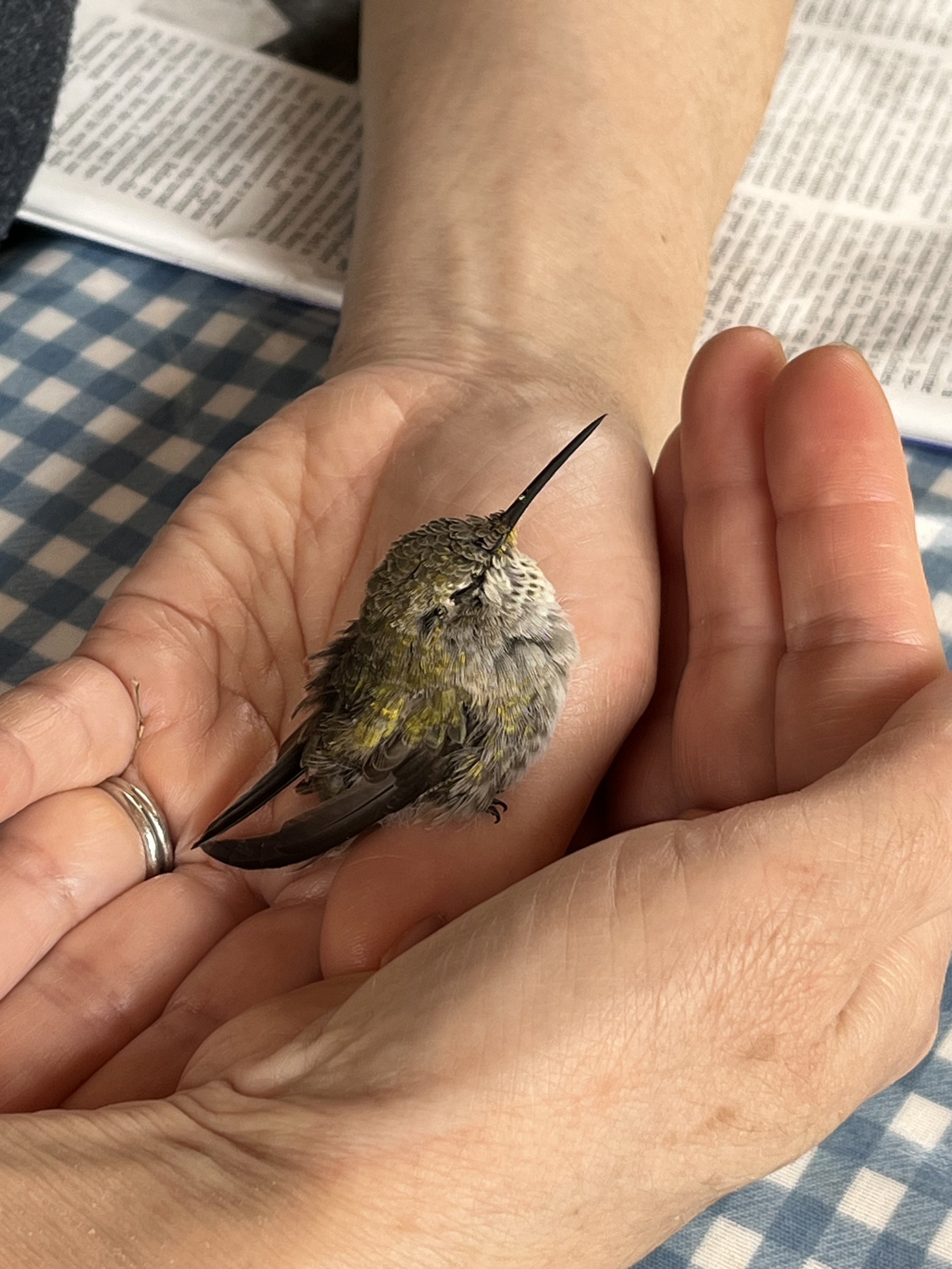
This morning, just before a webinar on When Parenting Reopens Trauma Wounds, I found a baby hummingbird clinging to a canvas chair in our backyard. It looked distressed, possibly injured, and unable to fly.
I gingerly brought it onto the deck and asked my husband to give it some nectar with a syringe. Resting in the palm of my hand, the tiny bird sipped a little. I began to worry that I might have to miss the webinar and rush it to a wildlife rescue. But then, quite suddenly, it perked up and flew away in an instant. I assumed it had only been stunned after colliding with the chair. I felt tremendous relief, grateful that it was okay, and joined the webinar moments later.
Hummingbirds are widely loved, but I had never seen one until I was sixteen, while staying with a host family in California. (I don’t believe we have hummingbirds in Japan.) My host mother kept a hanging basket of fuchsias and a nectar feeder outside the kitchen window. I still remember the sense of awe the first time I saw one hovering and darting from flower to flower. That memory is now nearly fifty years old.
Here in Seattle, I have created a hummingbird-friendly backyard garden with feeders, hardy fuchsias, honeysuckle, grevillea, and salvia. Now, a dozen or so come and go throughout the day. It still amazes me that such tiny creatures can consume the equivalent of several cups of nectar in a week.
In many spiritual and folklore traditions, hummingbirds are seen as messengers—symbols of love, resilience, and an invitation to notice life’s sweetness. I interpreted this morning’s encounter as a kind of blessing. I happened to be in the right place at the right time, able to help a fragile life recover its strength.
When I joined the webinar, I carried with me a lingering sense of calm and gratitude. The image of that tiny bird—once fragile and helpless—flying away, stayed with me. This was a much-needed lift—small and quiet, but deeply felt.