After hearing Richard Schwartz’s session at the 37th Boston International Trauma Conference, which I joined virtually from Seattle, I wanted to learn more about his Internal Family Systems (IFS) framework. I signed up for his recent webinar, An IFS Approach to Secure Internal Attachment and Regulation. As I listened, I began thinking again about a conch shell dream I had about a month earlier.
I was already familiar with the idea that we contain different parts, but Schwartz’s perspective felt particularly resonant because it does not pathologize any of them. The idea of Self in IFS also felt familiar to me, like the Higher Self I was introduced to in Freefall writing retreats, where we were taught to write from a place beyond the reach of ego. I still remember the first time I shared my childhood stories with a small group there in 2007. Seeing others moved—some even weeping and reaching for Kleenex—was heart-opening and filled me with gratitude. I felt truly seen, heard, and valued for who I was and what I had gone through. That experience showed me how powerful and healing it is to be witnessed and validated.
Schwartz said that people with attachment wounds often look outward for soothing and validation in order to feel okay. He emphasizes, however, that healing requires unburdening our parts and turning inward to access the mature, wise adult Self for insight and reassurance. That is not easy for me because I grew up with attachment wounds and absorbed some Japanese cultural conditioning that emphasized comparison and external validation. I have carried that heavy burden all my life, so its roots run deep.
The conch shell dream mirrored that struggle. Finding an intact conch shell on the empty beach felt like discovering something precious and preserved in me, after years, even decades, of rough weather, including the unexpectedly difficult ordeal of publishing my book. But I left it behind in the lobby while rushing to join the group bus, and when I returned to retrieve it, it was gone.
Looking back, I can see the heaviness in my body and my reluctance to board the bus as a warning. It felt like my body and Self were telling me that if I forced myself back into that group rhythm, I might lose touch with the part of me I worked so hard to preserve. It reminded me to listen inward and honor my own boundaries. I am done with toxic hustle culture. I no longer want to go where I feel pulled simply because others are going.
I wrote a memoir about childhood emotional neglect. Part of the healing came from letting the neglected parts of me extract that intact conch shell and give voice to its history. But the relief and grief are now interwoven. When the dream ended, I realized it had not really resolved; I was left sitting at a crossroads. So I changed the ending in my mind. I went back to the lobby, found that once-lost plastic bag containing the conch shell, and chose not to board the group bus. Instead, I stayed alone on the peaceful beach.
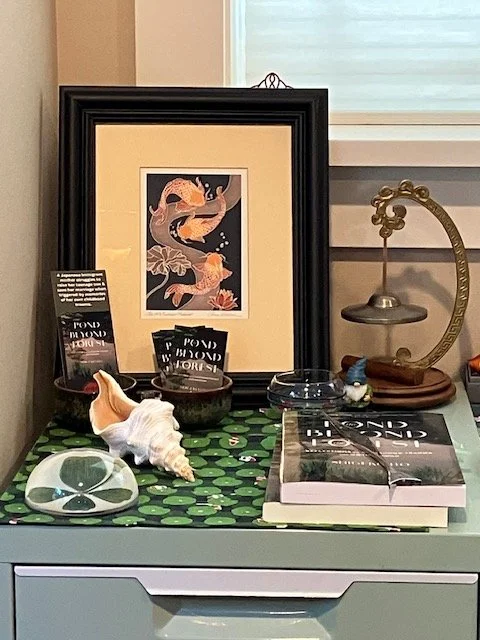
Processing the end of such a massive creative endeavor has taken a heavy toll on my psyche—more than I expected, and perhaps more than writing the book itself. But it is time for all my parts to come home together and mark this achievement. I later ordered a conch shell from Etsy and placed it on my Pond Book shrine as a touchstone. It reminds me that even though something in the dream was jarring, I get to choose how it ends.